
Beyond the Screen: Why AI Won’t Kill Software, It Will Embody It in Spatial Computing
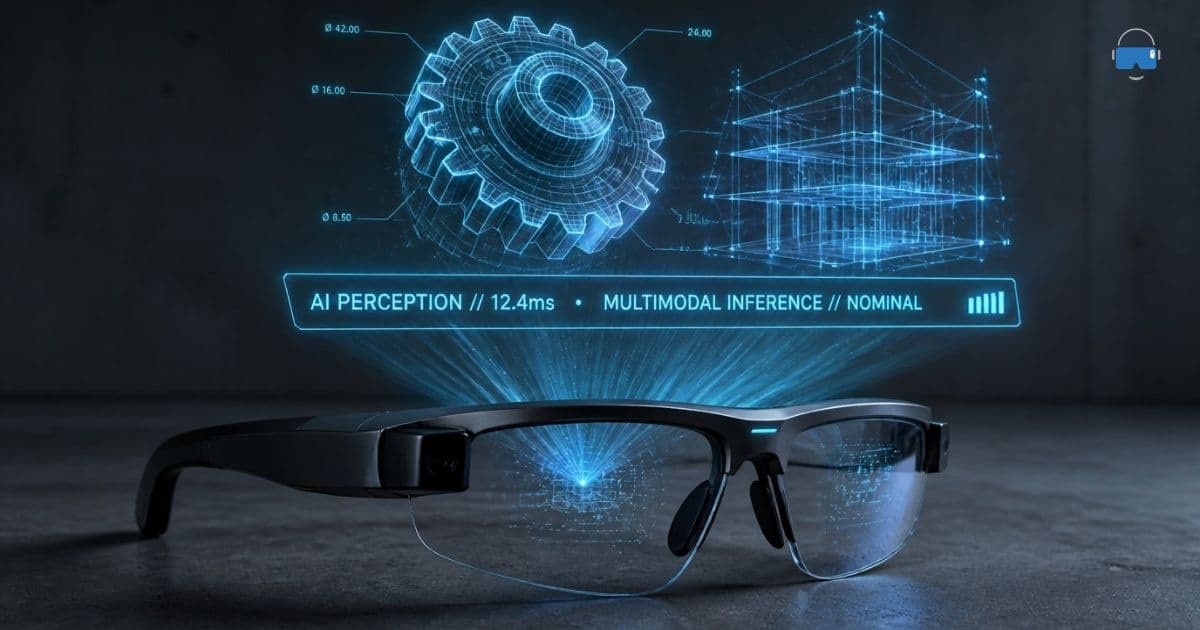
The prevailing consensus across tech commentary insists that generative artificial intelligence is about to cannibalize the software industry. As autonomous agents write code, synthesize dashboards, and execute workflows on command, the traditional application stack—and the per-seat SaaS subscription model that monetized it—is widely projected to collapse.
Yet, this panic makes a fundamentally flawed assumption: it presumes that human computing will remain permanently trapped behind a six-inch pane of gorilla glass.
Confined within a smartphone screen or browser tab, a Large Language Model (LLM) is little more than a disembodied brain operating in a sensory vacuum. It can generate thousands of lines of boilerplate code or parse financial spreadsheets, but it cannot see what tool a field technician is holding. It cannot observe the vibration frequency of a failing industrial pump, verify whether a cleanroom operator properly seated a sterile seal, or identify hazardous pinch points during high-risk offshore operations. Text-box computing has already hit diminishing cognitive returns.
Conversely, for the past fifteen years, the Extended Reality (XR) sector built a pair of eyes with no brain. Early headsets and smart glasses struggled precisely because every polygon, collision box, and interaction tree had to be laboriously scripted and rendered by hand. Users were forced to navigate cumbersome floating menus via fatiguing air-taps or fiddly micro-touchpads.
Multimodal AI does not destroy spatial computing; it provides the cognitive operating system that XR has always lacked. In return, spatial computing provides AI with the egocentric, real-world physical grounding it desperately needs to interact with human reality.
The Core Architectural Inversion
The software industry is not vanishing—it is escaping the screen. When multimodal vision models achieve continuous semantic comprehension of human physical space, the physical environment itself becomes the interface. Software ceases to be a destination that operators sit down to navigate; it becomes an invisible, ambient layer of cognitive assistance mapped directly onto the physical world.
The Interaction Inversion: The Death of Hardcoded UI
For more than four decades, human-computer interaction has relied on the desktop metaphor: files, folders, rectangular windows, drop-downs, and form fields. The smartphone revolution merely shrank that desktop into touchable glass tiles.
Spatial AI completely upends this paradigm through the emergence of Ephemeral User Interfaces (EUI):
- No More Hand-Designed Pixel Canvases: Software will no longer be drafted screen-by-screen for iOS, Android, or web frameworks. Interfaces will be generated dynamically at runtime by multimodal vision models.
- Context-Driven Transient Visuals: A glowing 3D vector arrow appears for four seconds to indicate the exact torque sequence on a flange bolt, then vanishes. A floating line-chart showing pressure drop renders only while an engineer looks directly at a manifold gauge and dissolves the moment they shift their gaze.
- Zero-Touch Semantic Intent: Instead of drilling down through nested menus, user intent is inferred from head orientation, eye gaze fixation, ambient audio, and natural language queries.
Workflow Simulation: The 2D Friction Tax vs. The Spatial AI Loop
To understand why this shift is mathematically inevitable in industrial and mission-critical environments, compare the cognitive load and operational drag of legacy device computing against ambient spatial assistance:
Legacy 2D Device Tax vs. Zero-Friction Spatial AI
Diagnosing Unlabeled Machine Variance
- Operator detects abnormal thermal signature or acoustic pitch.
- Halts physical operations and steps away from the machinery.
- Ungloves hands, unholsters smartphone/tablet, and logs into ERP.
- Searches equipment database for plant line schematic (PDF).
- Pans and zooms a 2D PDF diagram to locate specific valve IDs.
- Mentally translates 2D schematic vectors onto complex 3D steel piping.
- Re-gloves, resumes work, and executes adjustment.
Egocentric Multimodal Identification
- Operator looks directly at the vibrating valve assembly.
- Asks aloud: “What is causing the pressure deviation here?”
- On-frame camera streams egocentric frame to edge multimodal model.
- Model queries SCADA, identifies Valve #B-14, and projects real-time pressure differential directly onto the pipe.
- An ephemeral cyan guide arrow highlights the counter-clockwise rotation required.
- Operator makes adjustment immediately with both hands free.
Aseptic Gowning & Line Clearance
- Operator enters Grade B cleanroom preparation airlock.
- Consults printed SOP laminated cards on the airlock bulkhead.
- Touches physical touchscreens or paper logbooks to confirm steps.
- Surface touches introduce potential microbial cross-contamination vectors.
- Requires dedicated QA inspector present for second-person visual sign-off.
Touchless Computer Vision Auditing
- Operator gowns under standard laminar airflow protocol.
- Wearable optical sensors automatically log visual gowning sequence.
- Multimodal vision verifies glove sanitization and face seal integrity in real time.
- Digital clearance stamp verified via WebXR without physical device contact.
- Tamper-evident, 21 CFR Part 11 compliant audit trail pushed to cloud.
High-Voltage Substation LOTO Execution
- Technician brings paper switching schedule into live switchyard.
- Manually reads breaker tag strings against 12-character panel serials.
- High cognitive load under 90 dB electrical hum and extreme weather.
- Risk of confirmation bias: misidentifying feeder breakers in identical switchgear bays.
- Arc flash boundary enforcement tracked manually via visual memory.
Active Spatial Spatial Boundary Locking
- Technician approaches 33kV switchgear rack wearing optical frames.
- Real-time spatial anchor projects color-coded safety boundaries on concrete.
- Camera locks onto optical QR/serial and confirms de-energized bus state.
- Target isolator handle illuminated in vibrant green; adjacent live bays shaded in flashing red warning hash marks.
- Switching order verified step-by-step prior to mechanical latch pull.
The Economic Fallout: What Happens to the Software Industry?
When computing escapes the screen, enterprise IT software spend will undergo a brutal Darwinian reallocation. The market will split sharply between obsolete form-fillers and mission-critical spatial infrastructure.
1. The Extinction of Flat “CRUD” SaaS
The overwhelming majority of modern enterprise B2B SaaS solutions are nothing more than thin web wrappers around relational databases—standard Create, Read, Update, Delete (CRUD) logic. They charge $50 to $180 per seat per month for employees to manually type observations into text boxes, click checkboxes, and view static pie charts.
This entire business model is facing existential obsolescence. If an enterprise operator wearing lightweight smart optics can look at a piece of machinery, a shipping container, or a cleanroom suite and verbally state: “Log 50 units received, zero seal damage, transfer to Bay 4,” the web form layer becomes dead weight. Software that exists solely to capture manual human keystrokes will see its enterprise value proposition collapse.
2. The Rise of “Spatial Systems of Record”
The software companies that survive and command market power will not build frontend dashboards. They will build the low-latency middleware, spatial coordinate anchors, and real-time streaming engines that bridge physical reality with enterprise intelligence:
- Egocentric Visual Indexing (“Search for the Physical World”): Enterprise search will transition from indexing text documents to querying continuous egocentric video streams. An operations lead will ask: “Did the third-shift crew torque the primary impeller seal before charging the vessel?” The spatial AI agent queries edge-cached spatial video from six hours prior, verifies the mechanical position, and confirms compliance in under 300 milliseconds.
- Spatial Data Topology & Digital Twins: The enduring economic moat belongs to platforms that can maintain millimeter-accurate, spatial coordinate meshes of physical facilities (factories, offshore platforms, cleanrooms, logistics yards) and stream those digital assets instantly via zero-install browser standards like WebXR.
The Engineering Reality: The Split-Compute Architecture
To understand how this transformation will actually unfold, technical leaders must look beyond consumer tech hype and confront the rigid laws of physics. All-day wearable eyewear cannot exceed 70 grams without inducing localized facial pressure and headaches. Concurrently, thermal dissipation on the bridge of a human nose cannot safely exceed 2.5 Watts.
You cannot mount a 45-Watt neural processor, a cooling fan, and a 4,000 mAh battery on someone's face. The future belongs entirely to a Three-Tier Split-Compute Pipeline:
The Three-Tier Spatial AI Split-Compute Pipeline
On-Frame Ultra-Low Power Ingestion
<15ms Latency WindowDedicated strictly to real-time spatial positioning and zero-lag motion tracking. Executes no heavy LLM inference locally to preserve sub-70g weight and maintain temperatures under 38°C.
Local Edge Tokenization & Spatial Anchor Relay
30 – 50ms Latency WindowHoused in a pocket puck, ruggedized cleanroom tablet, or enterprise smartphone. Connects to the optical frame via low-latency Ultra-Wideband (UWB) or Wi-Fi 7 wireless tethering.
Deep Multimodal Reasoning & Spatial Systems of Record
150 – 300ms Asynchronous LoopOperates asynchronously across on-prem private servers or sovereign cloud infrastructure. Connects live spatial coordinate queries with enterprise ERP, SCADA telemetry, and historical compliance logs.
The Asynchronous Latency Partition
In a traditional 2D web application, if an AI model takes 2.5 seconds to generate an answer, the user barely notices. But in spatial computing, if a visual tracking anchor lags behind head motion by more than 20 milliseconds, the user experiences vestibulo-ocular disorientation—triggering instant motion sickness and visual fatigue.
This fundamental physiological constraint dictates that spatial AI architectures must strictly decouple Real-Time Physical Perception (<15ms on-device loop) from Cognitive Reasoning (>200ms cloud loop). The headset must anchor spatial vectors locally with rock-solid stability, while the AI's cognitive guidance arrives asynchronously as a non-blocking ambient overlay.
Conclusion: Escaping the Glass Compromise
The smartphone was an extraordinary historical breakthrough, but it represented an undeniable ergonomic compromise: immense computing power trapped behind an isolated handheld slab of glass that constantly forces humans to disengage from their physical surroundings to interact with digital logic.
By pairing multimodal reasoning (the cognitive engine) with lightweight spatial optics (the ambient interface), computing finally escapes the screen.
The software industry is not facing destruction; it is maturing into its final, embodied form factor. The leaders of the next computing epoch will not be those who design marginally cleaner web dashboards. They will be the architects who connect low-latency spatial digital twins, egocentric vision intelligence, and zero-friction WebXR infrastructure to empower human operators in the physical world.
Bridge Your Industrial Enterprise into the Spatial AI Epoch
Discover how GRAHAs VR deploys enterprise-grade WebXR platforms and spatial digital twins to transition industrial operations from friction-heavy 2D screens to zero-install ambient computing.


Frequently Asked Questions
Will generative AI make software applications obsolete?
Generative AI will not eliminate software; it will force it out of 2D screens. The software layer that is becoming obsolete is flat “CRUD” SaaS—basic multi-tenant databases wrapped in forms and web dashboards. The software of the future consists of low-latency spatial middleware, physical coordinate anchors, and multimodal vision pipelines connecting enterprise data lakes directly to wearable optical waveguides.
Why did early XR smart glasses struggle before the rise of multimodal AI?
For over a decade, XR hardware represented “eyes with no brain.” Every 3D mesh, collision boundary, and interaction tree had to be laboriously hand-modeled and hardcoded. Navigating static floating 2D menus using hand gestures or micro-touchpads caused cognitive fatigue. Multimodal AI provides continuous semantic perception, allowing the physical world itself to become the dynamic interface without pre-scripted UI trees.
What is an Ephemeral User Interface (EUI) in Spatial Computing?
An Ephemeral User Interface is a transient visual or auditory affordance synthesized dynamically at runtime by multimodal vision models. Unlike static software screens that users must intentionally open and manage, an EUI—such as a 3D vector alignment arrow or an anomalous thermal boundary—appears only for the few seconds an operational ambiguity exists and dissolves immediately once resolved.
How does the split-compute architecture resolve thermal and weight constraints in smart glasses?
Human ergonomic limits restrict all-day eyewear to under 70 grams, which limits thermal dissipation to under 2.5 Watts. The split-compute architecture solves this by offloading high-TDP compute: on-frame ASICs manage low-latency sensor ingestion and 6-DoF SLAM (<15ms), while a wireless pocket host or local edge server handles heavy multimodal tokenization, vision embeddings, and asynchronous cloud reasoning (>200ms).