
The Spatial Computing Paradigm: Why XR is the New Epicenter of Enterprise Operations
March 17, 2026
For the past few years, Extended Reality (XR) has been put into a box. Ask most enterprise leaders what VR or AR is for, and they will give you one answer: Training. While XR has revolutionized workforce onboarding, confining it to the classroom fundamentally misunderstands its potential.
GRAHAs VR ® is an award-winning XR (Extended Reality) startup based in Chennai, India. We specialize in customized Spatial Computing solutions for heavy industries, including Manufacturing, Shipping, Pharma, and Logistics. We are entering the era of Spatial Computing, where XR is no longer just an application—it is the epicenter of how human workers interact with digital data, AI, and physical machinery across the factory floor.
The Limitations of 2D in a 3D World
The industrial world is inherently three-dimensional, yet for decades, we have forced our workforces to interpret physical tasks through flat, two-dimensional mediums. A thick PDF manual, a spreadsheet of IoT sensor data, or an instructional video on an iPad—these do not react to the user, they do not simulate the stress of the environment, and they leave a massive cognitive gap between theory and execution.
They need a spatial interface. By blending contextual intelligence with spatial visualization, we create environments where data lives on the physical world.
A Multi-Industry Paradigm Shift
Across our deployments in India, the USA, Australia, and Nepal, we have mapped out exactly how Spatial Computing replaces static operations:
1. Operational Maintenance & Assembly Precision engineering requires precision visualization. Using AR overlays, technicians see step-by-step digital instructions superimposed directly onto physical components.
2. Precision Skills Transfer Muscle memory cannot be learned from a PDF. We simulate highly tactile, precision-heavy tasks in a zero-risk environment, ensuring technicians are fully proficient before they ever touch expensive physical materials.
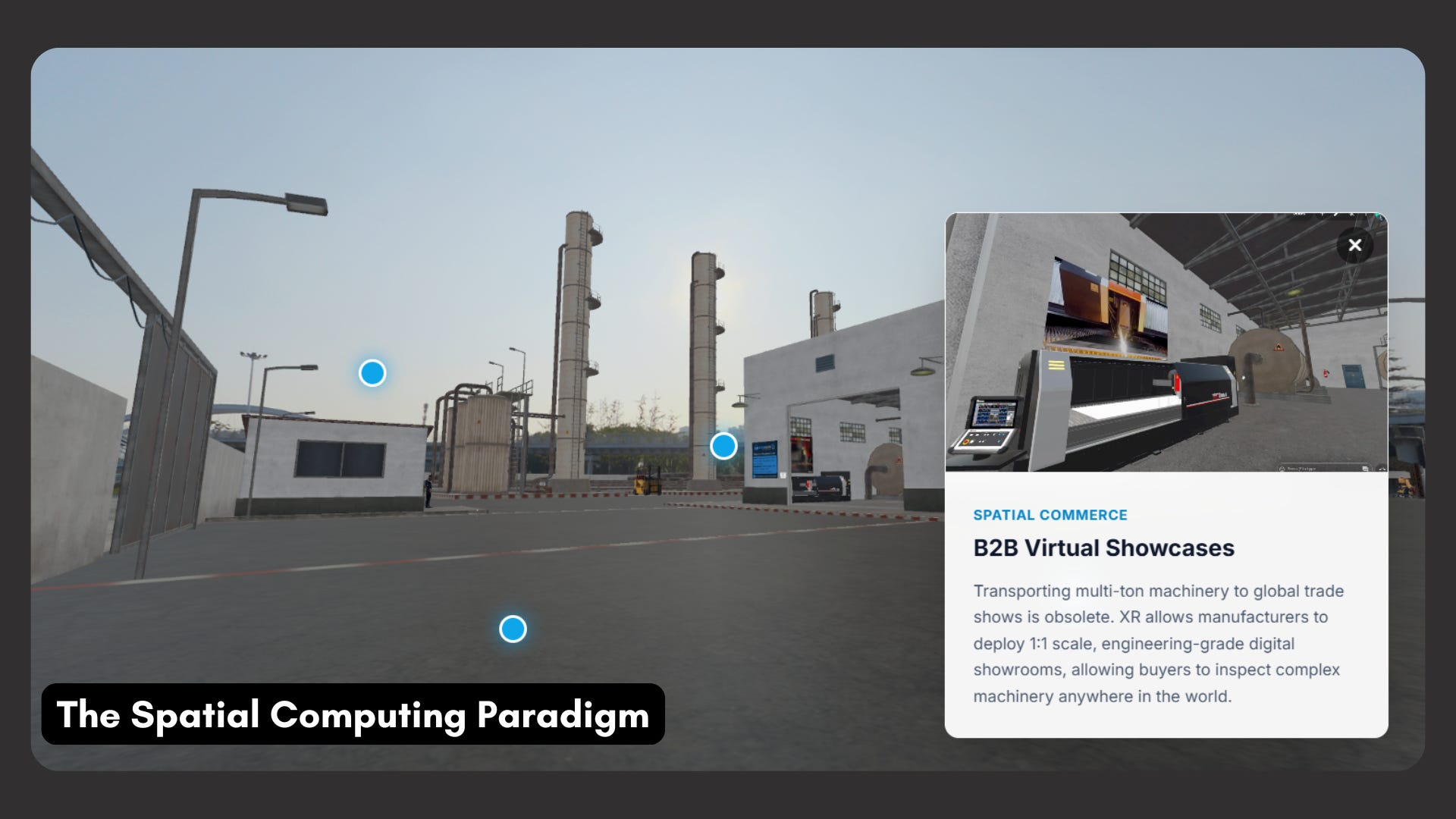
3. Spatial Commerce & B2B Showcasing Transporting multi-ton machinery to global trade shows is obsolete. XR allows manufacturers to deploy 1:1 scale, engineering-grade digital showrooms, allowing buyers to inspect complex machinery anywhere in the world.
4. Enterprise EHS (Zeal X Safety) We transform mandatory compliance into high-stress, risk-free simulations. By triggering the brain's natural retention mechanisms, workers are actually prepared for real-world hazards, drastically reducing factory floor incidents.
Engineering the Human Connection: The STEP Framework™
Whether we are building a digital twin for an assembly line or an interactive WebAR marketing asset, the technology only works if the human brain accepts it.
Our proprietary STEP Framework™—published in the International Journal of Innovative Technology and Creative Engineering (IJITCE)—bridges the cognitive gap in industrial training by leveraging neuroscience:
S - Story (Narrative Learning): Contextualizes tasks to increase retention by 4x.
E - Emotion (Limbic Engagement): Uses VR to trigger hormonal memory markers for long-term retention
P - Place (Contextual Learning): Utilizes 1:1 Digital Twins to leverage environmental encoding.
Measurable ROI
The shift from 2D manuals to Spatial Computing is a fundamental driver of operational efficiency. Enterprises utilizing our solutions report a 60% faster Time-to-Proficiency for new hires. Furthermore, by utilizing AR overlays for complex engineering tasks, we have recorded a 40% decrease in assembly line errors using AR overlays.
Experience the Spatial Web: We have built an interactive blueprint of a Smart Factory to demonstrate these technologies in real-time.