Spatial Computing for Offshore Fatigue Management: Engineering Human Reliability
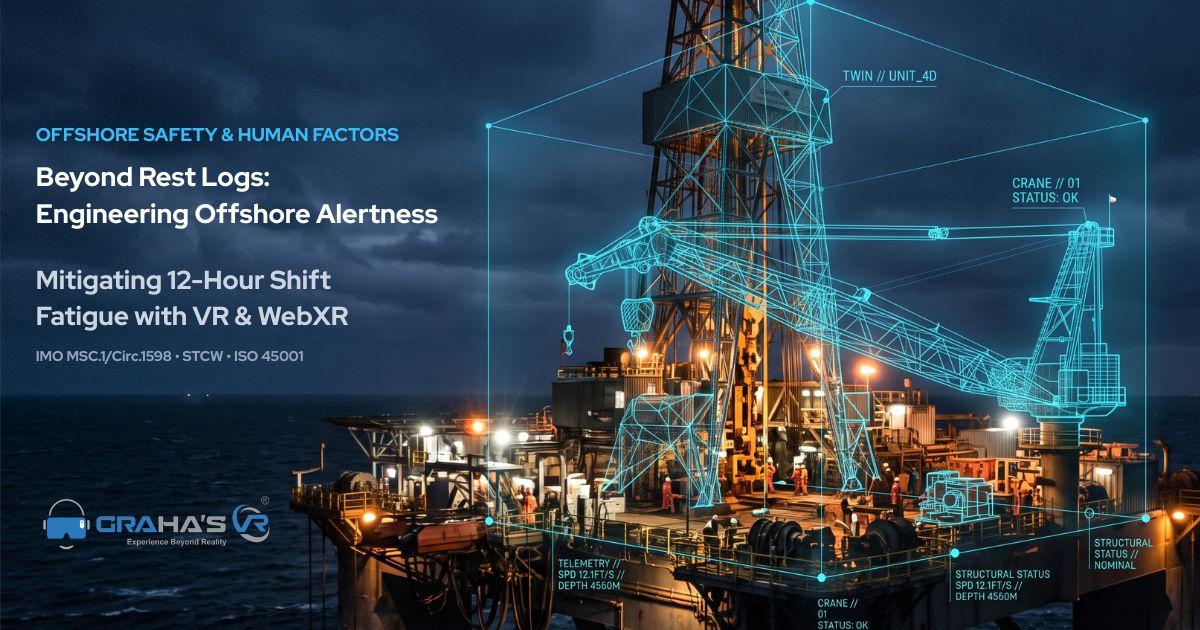
On an offshore drilling installation, production platform, or subsea support vessel, the most volatile operational risk is rarely mechanical failure—it is the silent, unmeasured deterioration of human cognitive bandwidth during rotating 12-hour shifts.
When an offshore crane operator or dynamic positioning officer (DPO) misinterprets a secondary alarm at 03:45 on Day 12 of a 21-day tour, the breakdown is rarely a lack of technical knowledge. It is neurobiological. Under chronic sleep debt, circadian disruption, and constant environmental vibration, the brain’s prefrontal cortex exhibits measurable micro-delays in sensory processing. The operator looks directly at a pressure indicator or sea-state vector, yet fails to register its deviation.
For decades, offshore operators have managed this systemic risk with backward-looking administrative tools: self-reported hours-of-rest spreadsheets and biennial classroom lectures. In high-consequence environments where downtime costs exceed $25,000 per hour and safety incidents incur multi-million-dollar liabilities, passive documentation is no longer a defensible barrier.
Spatial computing—bridging high-fidelity Virtual Reality (VR) simulations with zero-friction WebXR accessibility—presents a fundamental paradigm shift: transitioning fatigue risk management from retrospective compliance to proactive, experiential cognitive conditioning.
The Regulatory Mandate: Beyond the Logbook Defense
International regulatory bodies have closed the gap between paperwork and competence. IMO MSC.1/Circ.1598 (Guidelines on Fatigue) explicitly mandates that safety management systems address the operational human factors underlying fatigue-related incidents. Concurrently, the STCW Manila Amendments and ISO 45001:2018 Clause 8.1.2 demand proactive engineering controls that verify crew fitness and situational readiness before safety-critical tasks commence.
Circadian Shift Engineering: Anatomy of the 03:00 Crisis
Offshore fatigue cannot be evaluated through the lens of standard industrial fatigue. Crews live inside their industrial asset, subjected to continuous 24/7 noise floors (often exceeding 70–75 dB in accommodation modules), low-frequency hull vibration, and radical swing-shift schedules (e.g., alternating between 12-hour day and night shifts midway through a rotation).
Human cognitive reliability offshore follows predictable, physiological decay curves:
- The Circadian Trough (02:00 – 06:00): Core body temperature drops, melatonin secretion peaks, and neurological latency increases by up to 300%. Reaction times degrade to levels mathematically comparable to a 0.05% blood alcohol concentration.
- The Day 10–13 Saturation Trough: During standard 14/14 or 21/21 hit rotations, cumulative sleep debt peaks toward the end of the second week. While technical confidence remains high, peripheral hazard perception drops sharply—leading to hand injuries, dropped objects, and misaligned valve line-ups.
- Cognitive Tunneling Under Stress:When an unexpected telemetry alarm sounds during severe weather, an exhausted technician's field of cognitive focus narrows to a single visual indicator, completely disregarding adjacent system alarms.
The Dual-Layer Solution: Virtual Reality & Cross-Platform WebXR
Immersive Virtual Reality has established an indisputable track record across high-hazard defense and aviation sectors: studies consistently demonstrate that immersive 3D simulation drives up to 4x faster learning curves and 75% higher knowledge retention compared to traditional classroom modules.
However, offshore environments require operational flexibility. You cannot always distribute dedicated VR headsets to every third-party contractor, nor can safety superintendents halt live deck operations for lengthy classroom sessions.
This is where Spatial Computing delivers an enterprise breakthrough. By authoring content on standardized spatial computing frameworks, safety simulations can be deployed across a unified spectrum:
Full Immersive Virtual Reality (VR)
Deployed in onshore training centers, platform safety briefing rooms, or via standalone headsets. Delivers deep, 6-DoF sensory presence where operators physically interact with complex machinery, drill consoles, and emergency muster protocols under simulated high-fatigue conditions.
Cross-Platform WebXR on Rig Devices
Deployed directly through standard web browsers onto existing rugged tablets, bridge consoles, and smartphones. Technicians complete 3-minute interactive spatial refreshers prior to safety-critical shifts without downloading proprietary client software or bypassing IT security firewalls.
Operationalizing the STEP Framework for Cognitive Alertness
Simulation only alters human behavior when it engages emotional memory. GRAHAs VR applies its peer-reviewed STEP Framework (Story, Emotion, Place) to transform static procedures into high-retention cognitive benchmarks:
1. Story (Dynamic Operational Context)
Instead of abstract multiple-choice quizzes, the simulation casts the operator into a high-stakes scenario situated at the tail end of a demanding night shift—such as identifying a subtle dynamic positioning drift or gas alarm anomaly amid weather-induced deck movement.
2. Emotion (Cognitive Friction & Pressure)
By replicating authentic auditory clutter, conflicting operational priorities, and degraded visibility, the simulation recreates the visceral drag of exhaustion. Operators experience their own delayed response times, establishing conscious self-awareness before stepping onto the live rig floor.
3. Place (1:1 Engineering-Grade Digital Twins)
The digital environment is a millimeter-accurate digital replica of the operational space—from the drawworks and BOP control panel to the manifold valve arrays. Motor memory built inside spatial computing transfers directly to physical steel without cognitive translation lag.
Operational Timeline: Circadian Degradation vs. Intervention Windows
Traditional Fatigue Risk Management Systems (FRMS) are retrospective—they record that an operator was legally rested before the shift, and log their sleep diary after the shift is over. Between 02:00 and 05:00, when cognitive latency spikes and well-control incidents peak, administrative controls offer zero active protection on deck.
12-Hour Offshore Night Shift: Cognitive Bandwidth vs. Incident Window
Crews start shift at 18:00 fully compliant on paper. Between 02:00 and 05:00, neurological fatigue causes a steep drop in peripheral hazard recognition. The administrative FRMS records rest-hours at shift completion (06:00)—hours after near-misses have already transpired.
During the 17:45 Toolbox Talk (TBT), operators run a 3-minute spatial drill of critical lift paths or valve alignments in VR/WebXR. Sensory conditioning elevates situational recall, insulating the operator against the deepest cognitive valleys of the 03:00 window.
The IT & Operational Architecture: Enterprise-Grade & Bandwidth Conscious
A common apprehension among offshore operations executives is infrastructure compatibility. Remote platforms often operate on constrained satellite uplinks (VSAT), and enterprise IT policies strictly prohibit downloading unvetted third-party executables onto corporate networks.
Modern spatial computing architectures solve these operational constraints at the engineering level:
- Zero-Client Footprint: WebXR modules run entirely within secure, sandboxed browser sessions (Chrome, Edge, Safari). No app installations, no device management (MDM) conflicts, and zero software provisioning friction.
- Bandwidth-Conservative Asset Delivery: Digital twin assets are streamed using compressed, modular 3D spatial pipelines. Once cached locally on a platform tablet or terminal, the simulation executes locally without placing ongoing demands on satellite bandwidth.
- Enterprise LMS & SCORM/xAPI Integration: Performance metrics—such as procedural sequence compliance, reaction latency, and decision accuracy—integrate directly into existing enterprise safety management systems (SAP, Oracle, Workday).
The Business Case: Mitigating Non-Productive Time (NPT) & Risk
For C-suite energy executives and vessel operators, investing in spatial fatigue management is fundamentally an asset protection and uptime strategy:
- Preserving Non-Productive Time (NPT): A single dropped object on a drill floor or a crane misalignment event can halt operations for 36 to 72 hours, costing hundreds of thousands of dollars in lost production and standby rates.
- Insurance & Underwriting Advantages:Underwriters are increasingly scrutinizing human-factor management systems. Demonstrating proactive, auditable pre-task spatial verification provides leverage during P&I club and marine insurance risk assessments.
- Crew Retention & Safety Culture: Replacing tedious paperwork with intuitive, respectful simulation tools builds genuine trust with offshore crews, directly lowering rotational attrition and contractor turnover.
Deploy Spatial Safety Across Your Offshore Fleet
Explore how GRAHAs VR partners with offshore operators to engineer tailored digital twins and high-retention safety training modules. Auditable compliance, proven cognitive retention, zero operational friction.


Frequently Asked Questions
How does spatial computing transform Fatigue Risk Management Systems (FRMS) offshore?
Spatial computing transitions fatigue management from retrospective paperwork (rest-hour logs) to predictive cognitive inoculation. By running high-consequence operational drills in 1:1 digital twins, crews experience and recognize degraded reaction times and sensory saturation in VR or browser-based WebXR before stepping onto a live deck.
What international regulations mandate offshore fatigue risk mitigation?
Key mandates include IMO MSC.1/Circ.1598 (Guidelines on Fatigue), the STCW 2010 Manila Amendments regarding minimum rest hours and fitness for duty, and ISO 45001:2018 Clause 8.1.2 requiring proactive hierarchy of controls to minimize human-factor operational risks.
Can spatial fatigue training be deployed across offshore assets without heavy IT overhead?
Yes. Modern spatial computing platforms support a hybrid architecture: immersive standalone VR headsets for deep simulation centers, and zero-install WebXR streaming directly via standard web browsers on rig-floor tablets and laptops over bandwidth-conscious VSAT satellite connections.
What is the business case for spatial fatigue management in offshore operations?
The business case centers on eliminating Non-Productive Time (NPT), lowering Total Recordable Incident Rates (TRIR), preventing catastrophic well-control incidents, reducing crew turnover, and securing favorable insurance underwriting terms through auditable cognitive competence data.